


A professional installation is only as good as two decisions made before the first bond or tape goes in: which method suits your natural hair, and which hair goes into it. Get both right and the fitting is quick, comfortable and blends without effort. Get either wrong and no amount of skill at the chair rescues the result. This guide explains what a proper fitting involves, how the main application methods differ, how to choose between them and what to ask before you book. It also shows why the quality of the hair you bring matters as much as the technician fitting it. If you are choosing hair for a fitting, our tape-in hair extensions and virgin hair bundles are a good place to start.
TL;DR
- A proper fitting starts with a consultation: hair and scalp check, method choice and consent, before any extensions go in.
- Method decides how long the result lasts. Tape-ins and sew-ins typically last 6 to 8 weeks, while keratin bonds and I-tips last around 3 to 6 months.
- Fine hair generally suits slimmer constructions such as tape-ins, and thick or coarse hair suits wefts or sew-ins.
- Keep added hair to roughly 10 to 15% of your own and never accept a fitting that hurts.
- Choose the hair first: 100% human hair in the right texture, length and weight gives any installation more to work with.
Table of Contents
- What happens at a professional fitting
- The main application methods compared
- How to choose the method that suits you
- How tape-in installation works
- What to ask before you book a fitting
- Protecting your own hair while wearing extensions
- Choose your hair, then your fitting
- Our view: quality hair makes the fitting
- FAQ
- Sources
What happens at a professional fitting
A good fitting is a process, not just an hour in a chair. UK hairdressing qualifications set out the stages, and they are a useful yardstick for what you should expect.
The consultation comes first
The ICM’s hair extensions qualification unit says a consultation should cover your preferences, goals, expectations, medical history, contra-indications, skin and hair analysis and informed consent. A contra-indication is simply a reason a treatment should not go ahead, such as a scalp infection. The stylist also assesses your natural hair for texture, density and health.
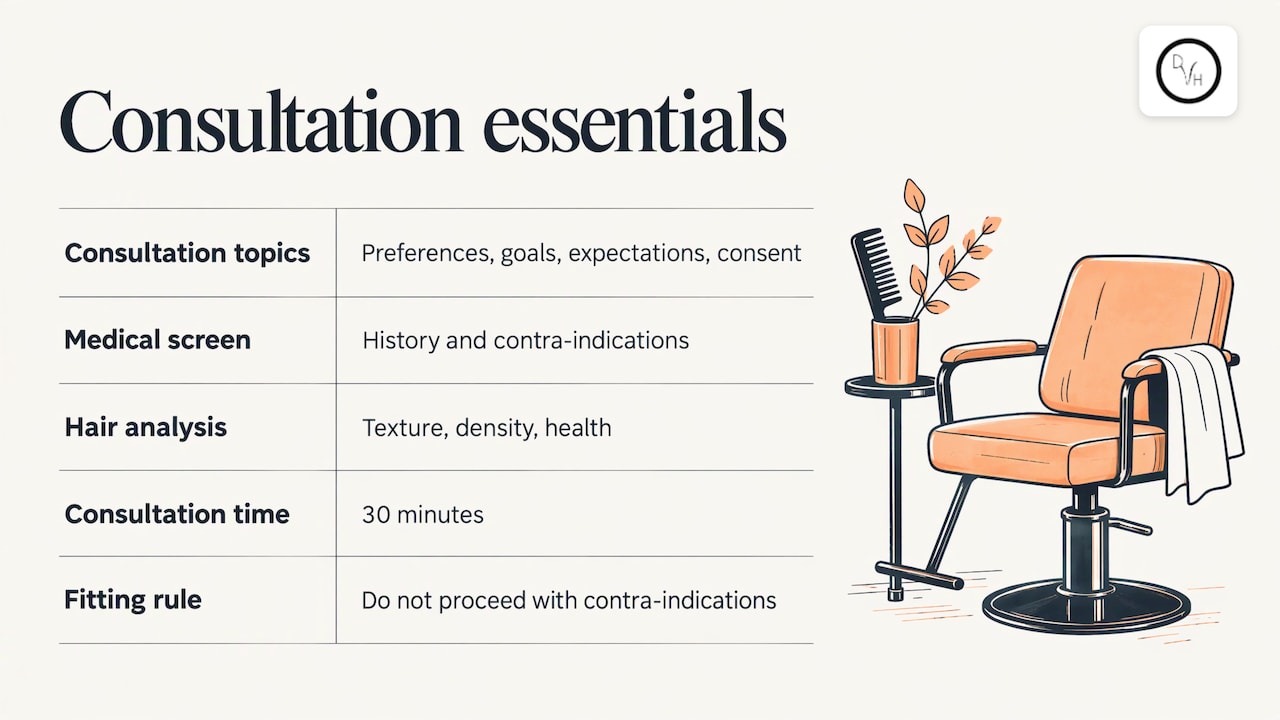
A Hodder Education textbook for UK hairdressing students says a client should be allocated 30 minutes for the consultation. During that time the stylist checks hair and scalp for suitability, agrees the type of extensions and chooses the most suitable technique. The same text says the stylist must not proceed if contra-indications such as traction alopecia (hair loss caused by pulling), broken skin, infection or hair-loss medication are present.
If a stylist skips straight to fitting without looking at your scalp or asking about your hair history, treat that as a warning sign.
Preparation and fitting
After the consultation the stylist sections your hair, prepares the extensions and attaches them according to the chosen method. Timings vary a lot by method and by how much hair is going in, so ask for an estimate when you book rather than assuming. A good stylist will also show you how the extensions sit, check comfort and explain how to wash and brush them.
Before you arrive
The stylist can only blend what they are given, so arrive with the hair you have chosen sorted by shade, length and texture. Match the depth of colour rather than chasing an exact tone. Vision Hair Extensions’ training guide makes the same point: look for the same depth of colour, not the exact tone. Natural hair varies from root to tip, so a close, slightly lighter or darker match often looks more natural than a perfect-on-paper one.
The main application methods compared
The Hair Extensions Association lists a long run of methods, including K-tip, tape-in, sew-in, beaded row, I-tip or microlink, nano ring, hand-tied wefts, clip-in, halo and braided extensions. The ICM curriculum gives the practical properties of the most common ones, summarised here.
| Method | How it works | Typical wear time | Best suited to |
|---|---|---|---|
| Tape-in | Thin wefts with adhesive sandwich your own hair | 6 to 8 weeks | Fine to medium hair |
| Sew-in (weft) | Wefts sewn onto a track of braided hair | 6 to 8 weeks | Thick, coarse hair |
| Keratin bond (K-tip) | Pre-bonded strands fused to small sections | 3 to 6 months | Those wanting a lasting, strand-by-strand finish |
| I-tip / micro ring | Strands held by small rings, no heat or glue | 3 to 6 months | Those wanting adjustable, bond-free fitting |
| Clip-in | Wefts you clip in and remove yourself | Temporary, reusable | Occasional volume and length |
The durations come from the ICM hair extensions unit, which also notes that human hair extensions look natural, can be heat-styled and coloured, and cost more than synthetic ones. Treat these as typical ranges: your hair growth, routine and the stylist’s technique all move them.
On our site you can browse each of these: tape-ins, genius wefts, machine wefts, I-tips and micro rings, K-tips and clip-ins.
How to choose the method that suits you
Work backwards from your own hair and life, not from what looks good on social media. A sensible order of questions:
- How healthy is your hair? Breakage, dryness or recent chemical services all limit what your hair can carry comfortably.
- How dense is it? Fine or low-density hair generally suits thinner constructions such as tape-ins or slim wefts. Thick, coarse hair copes well with sew-in wefts.
- What do you want? Length, fullness or both. Fullness needs more hair weight than length alone.
- How do you live? Exercise, swimming, travel and how much time you will give to upkeep all shape the choice.
- What is the whole budget? Include maintenance appointments, not just the first fitting.
That sequence follows a method-choice guide from a UK extensions brand and matches the way a consultation is meant to run.
Pick the hair to suit the method
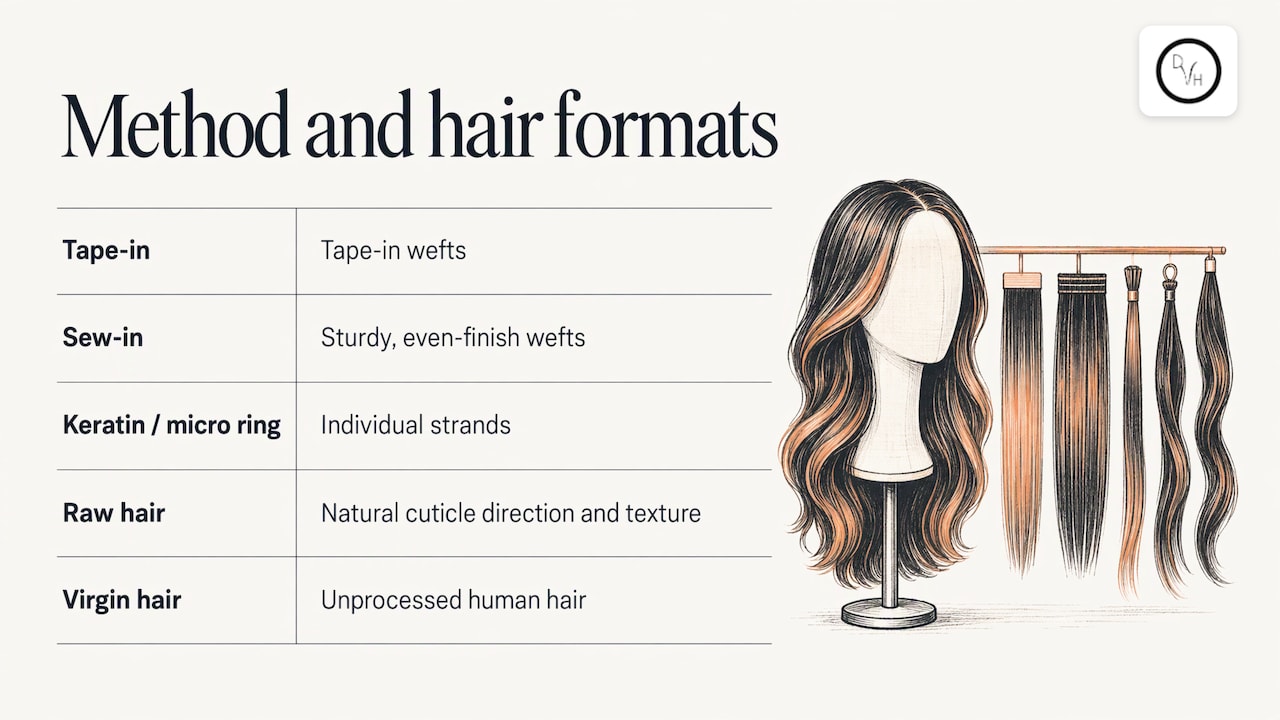
The method sets the hair format you need. Tape-ins need tape-in wefts. Sew-ins use wefts with a sturdy, even finish, such as our machine wefts or the slimmer genius wefts. Keratin and micro ring methods use individual strands. Choosing the right format is the step most people miss, and it decides whether the stylist can do their best work.
Then choose the hair type. Raw hair keeps its natural cuticle direction and texture, while virgin hair is unprocessed human hair. Our raw hair bundles and virgin hair bundles are made from 100% human hair, which can be heat-styled and coloured by a professional and blends with your own hair.
How tape-in installation works
Tape-ins are among the most searched methods, so here is the process in plain terms.
- Sectioning. The stylist divides your hair and lifts a thin layer along each row.
- Placement. One tape weft sits at the root under the layer, and a second is pressed on top, so your own hair is sandwiched between them.
- Staggering. Good placement leaves a small gap from the hairline and avoids stacking wefts directly on top of each other, which keeps the result flat and reduces strain on one area.
- Finishing. The stylist blends the length, cuts if needed and shows you how to brush and wash.
The quality of the weft matters here. A slim, flexible tape weft lies flatter against the scalp and is easier to place discreetly, which is why fine hair does well with this method. Our tape-in extensions are made from 100% human hair, and our guide to tape-in extensions in London covers what to expect from the method in more detail.
Tape-ins are reusable: a good stylist can lift them, replace the adhesive and move them up as your hair grows. That is why the hair you choose is an investment rather than a one-off cost.
What to ask before you book a fitting
You are entitled to know how your stylist works. These questions are reasonable and a confident professional will welcome them.
- Do you do a consultation first? The standard is a hair and scalp check before any decision is made.
- Which methods do you fit, and why do you recommend this one for my hair? A good answer refers to your density, texture and routine, not just to what is popular.
- Can I bring my own hair? Many stylists will fit hair you supply, as long as it suits the method. Check the format you need (tape wefts, wefts or strands) in advance.
- How much hair will go in? Ask how this compares with your own. The 2026 review in the Journal of Craniofacial Surgery Open recommends limiting the added mass to about 10 to 15% of native hair.
- What are the maintenance and removal steps? Ask how often you will need to come back, what that costs and who does the removal.
- What happens if it hurts? The answer should be that they stop and redo it.
Be wary of anyone who quotes a fixed amount of hair before looking at your head, or who will not discuss contra-indications.
Protecting your own hair while wearing extensions
Well-fitted extensions should be comfortable, but any method places some load on your hair. The same journal review recommends distributing that load with wider bonds or silicone-lined rings and following wear cycles of 6 to 8 weeks on, then 2 to 3 weeks off to prevent hair loss caused by the extensions themselves. A cycle like that suits tape-ins and sew-ins well, and many wearers use clip-ins during the rest period.
Warning signs
Tight, painful extensions need to be loosened or removed. A UK pharmacy guide lists the early signs of traction damage as a receding hairline, a band of short broken hairs along the front, scalp tenderness and small bumps. The same guide says smooth, shiny patches on the scalp can mean scarring and need prompt medical assessment. If you see any of these, have the extensions taken out and speak to your GP. Early-stage damage is typically reversible if the tension is removed promptly.
Day-to-day care
The basics are the same whatever the method: brush gently from the ends upwards, keep conditioner away from the attachment points, protect the hair from heat and rinse after swimming. Our beginner’s maintenance guide walks through a routine, and the wig and hair care range and luxury sleep protection make it easier to keep to. A silk or satin surface at night reduces friction on the roots, which is where extensions tangle first.
Choose your hair, then your fitting
If you have decided on a method, the next step is the hair. We sell 100% human hair in raw and virgin options, in a range of textures, lengths and styles, shipped to customers worldwide. For a tape-in fitting, start with our tape-in hair extensions. If you prefer wefts, look at our genius wefts. For temporary volume, our clip-in extensions go in and come out at home.
Stylists buying for clients can also browse the full range from the DVH Extensions home page, including I-tips and K-tips.
Our view: quality hair makes the fitting
People ask us how to find the best installation, and we turn the question around: what is going into your hair? A skilled stylist can blend almost anything, but they cannot make thin, tangle-prone hair behave like premium hair.
Since 2015 we have focused on premium raw and virgin human hair, because it is what natural blending, fullness and longevity depend on. Cuticle-aligned, unprocessed hair sits and moves like your own, takes heat styling and colouring from a professional and holds up through reuse and repositioning.
That is why we pair each method with the right format: slim tape-ins for fine hair, wefts for thicker hair, strands for bond and ring methods. Choose the format that suits your method, choose the texture and length that suit your life, and the fitting becomes a straightforward job for your stylist.
Dvh Extensions
FAQ
How long does a professional installation take?
It depends on the method and how much hair is going in. Tape-ins are usually quicker than keratin bonds or micro rings, because the hair goes in as wefts rather than strand by strand. Ask your stylist for an estimate at the consultation, as it also depends on your hair’s density and length.
How long will my extensions last after fitting?
According to the ICM curriculum, tape-ins and sew-ins last around 6 to 8 weeks, while keratin bonds and I-tips last 3 to 6 months. Clip-ins are temporary and reusable. The hair itself can often be reused if it is high-quality human hair and the method allows it, as with tape-ins.
Can I buy my own hair for a fitting?
Yes, many people choose their hair first and then arrange a fitting. Pick the format that matches your method: tape wefts for tape-ins, wefts for sew-ins, strands for bonds and rings. Our raw and virgin bundles are 100% human hair.
Can I colour or heat-style human hair extensions?
Human hair extensions can be heat-styled and coloured, according to the ICM hair extensions unit. Use heat protection, and have colouring done by a professional. Choosing a shade of the same depth as your own hair usually means you will not need to colour them at all.
What should I do if my extensions hurt?
Tell your stylist straight away and ask them to loosen or redo the section. Persistent pain, tenderness, broken hairs along the hairline or shiny patches on the scalp mean the extensions should come out, and you should see your GP.
Sources
- Hair Extensions, ICM CBQ unit
- Hair Extension Services (optional unit), Hodder Education
- Hair Extension Methods, Hair Extensions Association
- Hair Extensions: Anatomic, Biological, and Clinical, Journal of Craniofacial Surgery Open
- Do Hair Extensions Cause Hair Loss? Bolt Pharmacy
- How to Choose the Right Hair Extensions for Your Hair
- Vision Hair Extensions training guide


